

This is the only guide you’ll ever need, no experience, no coding, no large budget. Just a phone or laptop and the will to start.
What Is Blogging, And Why Kenya Is the Perfect Place to Start
A blog is simply a website where you regularly publish written content, articles, guides, stories, or opinions on a topic you care about. Think of it as your personal newspaper on the internet, except you own everything.
In Kenya, blogging has exploded. From lifestyle and travel to agriculture, finance, tech, and sports, Kenyan bloggers are earning real income and building real audiences. With over 5 million Kenyans actively searching Google every day, the opportunity has never been bigger and the good news is most niches are still wide open.
One powerful truth is that at any given moment, only3% of people are ready to buy, while97% are searching for information. Blogging is exactly how you reach that 97%. You educate them, build their trust, and by the time they’re ready to buy, they think of you first. This is the entire foundation of successful blogging.
You do not need to be a tech expert. You do not need to write perfectly. You do not need money. You just need to start, and this guide will show you every single step.
Step One: Choose Your Niche — Know Your “Dream Reader”
Your niche is the specific topic your blog focuses on. This is the single most important decision you will make. Many beginners want to “write about everything” yet this is a mistake. The riches are in the niches.
The Dream Buyer Principle
Before you write a single word, you must deeply understand who you are writing for. Ask yourself: What does my ideal reader struggle with? What are their biggest frustrations? What do they search on Google at midnight when they can’t sleep? The deeper you understand your reader, the more powerful your blog becomes.
Popular Profitable Blog Niches in Kenya.
- Personal Finance – Savings, investments, M-Pesa tips, side hustles, budgeting for Kenyans
- Travel & Tourism – Safari guides, budget travel, hidden gems in Kenya, Nairobi spots
- Agriculture – Farming tips, crop guides, agribusiness, greenhouse farming Kenya
- Tech & Freelancing – How to freelance online, tech reviews, remote work tips for Kenyans
- Food & Recipes – Kenyan recipes, healthy eating, restaurant reviews, meal prep
- Education – KCSE prep, university guides, scholarships, career advice for youth
How to Pick Your Niche (3 Simple Questions)
- What do you know or love – List 5 topics you enjoy talking about, even to friends. Passion keeps you going when it gets hard.
- Are people Googling it? – Open Google and type your topic. If Google auto-suggests it, people are searching for it. That means there’s demand.
- Can you make money from it? – Search “[your topic] affiliate programs Kenya” or “[your topic] ads Kenya.” If results come up, people are paying to be in that space, so you can earn from it.
Do Not Skip This Step
Starting a blog without a clear niche is like opening a shop that sells everything, nobody will remember you or come back specifically for you. Pick one focused topic and own it.
Step Two: Pick a Blogging Platform, Free vs Paid Options in Kenya
A blogging platform is the software that powers your blog. There are free options and paid options. Here’s everything you need to know:
| Plartform | Cost | Pros | Best For | SEO Friendly |
| WordPress.org | From Ksh 499/= per month | Full control, unlimited potential | Serious bloggers ready to invest | 100% – The Best |
| WordPress.com | Free (paid plans from ~Ksh 1,200/mo) | Easy, trusted, huge community | Beginners who want to grow seriously | 80% – Yes |
| Blogger | 100% Free | Zero cost, backed by Google, easy setup | Total beginners with no budget | 80% – Yes |
| Medium | Free | Built-in audience, clean design | Writers who want readers fast | Limited |
| Wix | Free / Ksh 900/mo | Drag-and-drop, pretty designs | Design-focused bloggers | Good |
Our Recommendation for Kenyan Beginners
Have Zero Budget? – Start with Blogger.com(free, owned by Google, easy to set up in 10 minutes)
Ready to grow seriously?- Go with WordPress.org+ affordable Kenyan hosting like Quincy Creative (from Ksh 499/month)
Want the best long term? – WordPress.org is the industry standard 43% of all websites on the internet use it.
Step 3: Set Up Your Blog in 20 Minutes (Step-by-Step)
We will use Blogger.com for the free route and WordPress.org for the paid route. Pick whichever suits you.
Option A: Free Blog on Blogger.com (0 shillings)
- Go to blogger.com – Open your browser (Chrome, Firefox, or any other) and visit blogger.com
- Sign in with Google– Use your Gmail account. If you don’t have one, create a free Gmail account first at gmail.com
- Click “Create New Blog” – Give your blog a title (e.g., “Nairobi Kitchen” or “Kenya Farm Guide”) and choose a free address like yourname.blogspot.com
- Choose a theme – Pick any design template that looks clean and easy to read
- Write your first post– Click the pen icon, type your article, add a photo, and hit “Publish.” That’s it , you’re live!
As you may have already noticed, your blog will always have .blogspot.com if you choose to go with Blogger.com. So if you are seriously ready to grow, see the option below on how to have your custom domain set.
Option B: Professional Blog on WordPress.org (Paid)
1. Register a domain Name
This is your address, e.g., yourname.co.ke or yourname.com. A .co.ke domain costs from Ksh 599/year where you register with Quincy Creative. Quincy Creative is an accredited domain registrar for by KENIC and is licensed by the Communications Authority of Kenya, so your digital assets will always be in safe hands. Choose something short, memorable, and related to your niche. Click here to see the guide on selecting a domain name
Ready to register your .co.ke domain?
2. Get Hosting
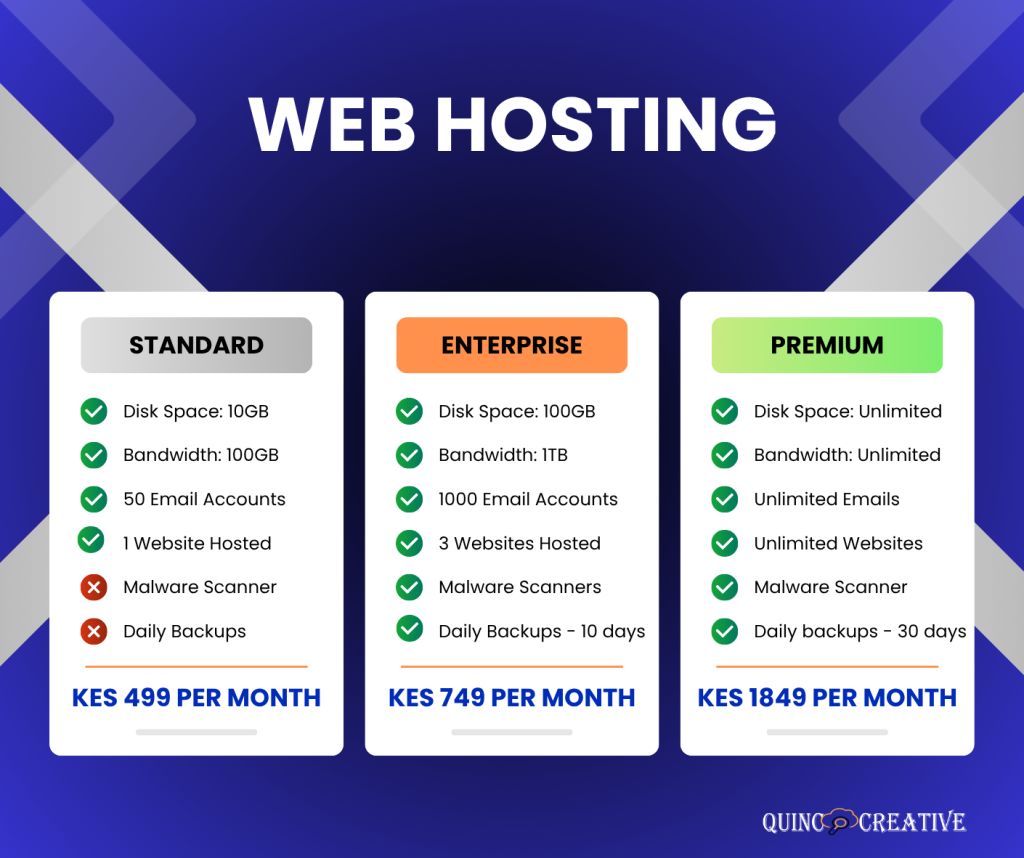
After registering your domain name. The next step is finding web hosting. Web hosting is a service that stores your website’s files and makes them accessible on the internet. Think of it like renting space on the web. Just as you need a shop for your business, hosting is the server where your files and data is stored. When someone types your domain name, their browser connects to the hosting server and searches for the respective files which it serves on their screen. Sign up for hosting at Quincy Creative starting at only KES 499 per month.
3. Install WordPress
Quincy Creative have a one-click WordPress install in their dashboard. Click it. WordPress will be ready in 2 minutes. See how to set up your wordpress account in our guide here.
4. Choose a free theme
Inside WordPress, go to Appearance → Themes → search for “Astra” or “GeneratePress” – both are fast, free, and look great.
5. Install 3 essential free plugins
Yoast SEO (helps you rank on Google), Akismet (blocks spam), and WP Super Cache (makes your site fast).
Your blog name (domain) is your brand. Keep it under 15 characters, easy to spell, and relevant to your niche. Avoid numbers and hyphens. Examples: NairobiEats.com, KenyaFarmer.co.ke, SavannahFinance.com. A good name is memorable and tells people exactly what you’re about.
Step Four: Write Your First Blog Post
Here is the truth nobody tells you: good blog posts are not about perfect grammar. They are about answering your reader’s questions clearly and helpfully. If you can explain something to a friend, you can write a blog post.
The Perfect Blog Post Structure (Copy This Every Time)
- Write a powerful headline— Your title must promise a clear benefit. Use formulas like: “How to [do X] in Kenya,” “Top 7 Ways to [Result],” or “The Complete Guide to [Topic] for Kenyans.” A better headline can triple your readership.
- Hook them in the first paragraph— Start with the reader’s biggest problem or a surprising fact. Don’t begin with “Hello, my name is…” Begin with their pain: “If you’ve ever tried to [problem] and failed, this post will change that.”
- Use subheadings (H2 and H3 tags)— Break your content into sections with clear sub-titles. Readers scan before they read. If your subheadings look interesting, they stay.
- Write in short paragraphs— Maximum 3–4 lines per paragraph. White space makes your content breathe and easier to read on mobile phones.
- Add real examples and local context— Mention Nairobi, Mombasa, M-Pesa, local brands. Kenyan readers instantly trust content that “gets” their world.
- End with a Call to Action (CTA)— Tell readers what to do next: “Leave a comment,” “Share this,” “Subscribe to get more,” or “Click here to read [related post].”
How Long Should a Blog Post Be?
For SEO and ranking in Kenya, aim for at least 1,200–2,000 words per post. Google rewards detailed, comprehensive content. Think about it: if someone searches “how to start a business in Kenya,” a 300-word post cannot compete with a detailed 2,000-word guide. Longer content = more trust + better rankings.
Step Five: SEO for Kenyan Bloggers, How to Rank on Google Kenya
SEO (Search Engine Optimisation) is the process of making your blog appear on the first page of Google when someone searches your topic. It is the single most powerful free traffic tool available to any Kenyan blogger.
Think of SEO as this: Google is a matchmaker. It wants to match searchers with the best answer. Your job is to prove to Google that your blog is the best answer for a specific search.
Key SEO Terms Every Kenyan Blogger Must Know
Keyword
The exact words people type into Google. E.g., “how to start farming in Kenya” is a keyword.
Long-Tail Keyword
A longer, more specific phrase. Less competition, easier to rank. E.g., “how to grow tomatoes in Kiambu County.”
On-Page SEO
Everything you do inside your post : title tags, headings, keywords, images, internal links.
Backlink
When another website links to your blog. Google sees this as a vote of confidence. More backlinks = higher ranking.
Domain Authority (DA)
A score (1–100) that measures how trusted your website is. New blogs start low; it grows over time.
Organic Traffic
Visitors who find your blog through Google search, free traffic that keeps coming without you paying for ads.
Search Volume
How many people search a keyword per month. You want keywords with decent volume but low competition.
Page Speed
How fast your blog loads. Google penalises slow sites. A fast blog ranks higher and keeps readers longer.
Mobile-Friendly
Over 80% of Kenyan internet users browse on phones. Your blog MUST look good on mobile or Google will not rank it.
How to Do Keyword Research (Free Method for Kenyans)
- Think like your reader— What would someone type into Google to find your post? Write down 10 possible phrases. These are your keyword ideas.
- Use Google’s own suggestions— Type your idea into Google. Before you press Enter, Google shows autocomplete suggestions. These are real searches by real people. Use them!
- Check “People Also Ask”— After you search, scroll down and look at the “People Also Ask” box. These are golden questions to answer in your blog posts.
- Use free tools— Ubersuggest (free plan), Google Keyword Planner (free with a Google account), or AnswerThePublic to find keyword volumes and ideas.
- Target local keywords— Add “in Kenya,” “Nairobi,” or specific counties to your keywords. E.g., “best savings account in Kenya 2025” will rank faster than just “best savings account.”
On-Page SEO Checklist , Do This For Every Post
- Put your main keyword in your title (the H1 heading at the top)
- Use your keyword in the first 100 words of your post
- Add your keyword to at least 2–3 subheadings naturally
- Write a compelling meta description (the short summary Google shows under your title), include your keyword and make it interesting
- Add alt text to every image (a short description of what the image shows,Google reads this)
- Include internal links— links to your other blog posts within the article
- Use your keyword in the URL slug e.g.,yoursite.com/how-to-start-blogging-kenya
- Aim for a post length of 1,200 words minimum
- Make sure your blog loads in under 3 seconds(test at pagespeed.web.dev)
- Ensure your site is mobile responsive
Kenyan-focused keywords are far less competitive than global ones. “How to invest Ksh 10,000” will rank much faster than “how to invest $100.” Always localise your keywords with Kenyan terms, currency (Ksh/shillings), and place names. This is your unfair advantage as a Kenyan blogger.
Technical SEO: The Things That Work Behind the Scenes
Technical SEO sounds scary but it just means making sure Google can easily find and read your blog. Here’s what to do:
Compress all images before uploading (use Squoosh.app free, works in your browser)
Install an SSL certificate(your site should start with https:// not http://) most Kenyan hosts give this free
Submit your blog to Google Search Console (free tool at search.google.com/search-console) this tells Google your blog exists
Create a sitemap.xml Yoast SEO plugin on WordPress does this automatically
Set up Google Analytics (free) to see how many people visit and which posts they love
Step Six: Promote Your Blog for Free, Get Your First 1,000 Readers
SEO takes 3–6 months to kick in. In the meantime, promote your blog using free channels that work very well in Kenya right now:
- WhatsApp Groups— Kenya has millions of active WhatsApp groups. Share your posts in relevant groups (farming groups, business groups, neighbourhood groups). Don’t spam — share when it genuinely helps the conversation.
- Facebook Groups— Find Facebook groups related to your niche (e.g., “Kenyan Farmers Network” or “Nairobi Entrepreneurs”). Provide value in discussions, then naturally mention your blog.
- Twitter/X— Kenyan Twitter (KOT — Kenyans on Twitter) is incredibly active. Share your blog content with relevant hashtags like #KenyaFarm, #NairobiLife, #KenyaFinance.
- Pinterest— Often ignored by Kenyan bloggers, but Pinterest drives massive free traffic especially for food, travel, lifestyle, and DIY niches. Create attractive pins for every post.
- Email Newsletter— From day one, collect email addresses. Use Mailchimp(free up to 500 subscribers). An email list is your most valuable asset unlike social media, no algorithm can take it away from you.
- Comment on other blogs— Leave genuine, helpful comments on popular Kenyan blogs related to your niche. This gets you noticed by the blogger and their readers.
Step Seven: How to Make Money Blogging in Kenya
Here’s the exciting part. Kenyan bloggers are earning real, consistent income. Here are the main ways to monetise your blog:
Google AdSense
Display Google ads on your blog. Earn every time someone clicks. Need ~50+ posts and consistent traffic first.
Affiliate Marketing
Promote other companies’ products and earn a commission. Jumia Kenya, Kilimall, and Booking.com have affiliate programs.
Sponsored Posts
Companies pay you to write about their products/services. Rates in Kenya range from Ksh 3,000 to Ksh 50,000+ per post.
Sell Digital Products
Create and sell eBooks, templates, courses, or guides. Example: “The Complete Guide to Greenhouse Farming in Kenya” sold as a PDF.
Online Courses
If you’re an expert, package your knowledge into a paid course. Use free platforms like Teachable or sell directly via M-Pesa.
Freelance Services
Use your blog to showcase expertise and attract clients who hire you for consulting, writing, photography, or other services.
0 Comments